
Fit the footprint to your packaging
The Euro-size deck is 1200 × 800 mm, compared with 1200 × 1000 mm for UK standard. Check carton layout, wrap clearance and the receiving customer’s footprint before choosing. If goods extend beyond the deck, revisit packing dimensions rather than assume the narrower pallet is interchangeable.
Measure overall height and check lower-board layout where conveyors or wrapping equipment are involved. These illustrations compare common dimensional concepts; they do not define licensed or exchangeable stock.
Fork entry and wheel clearance
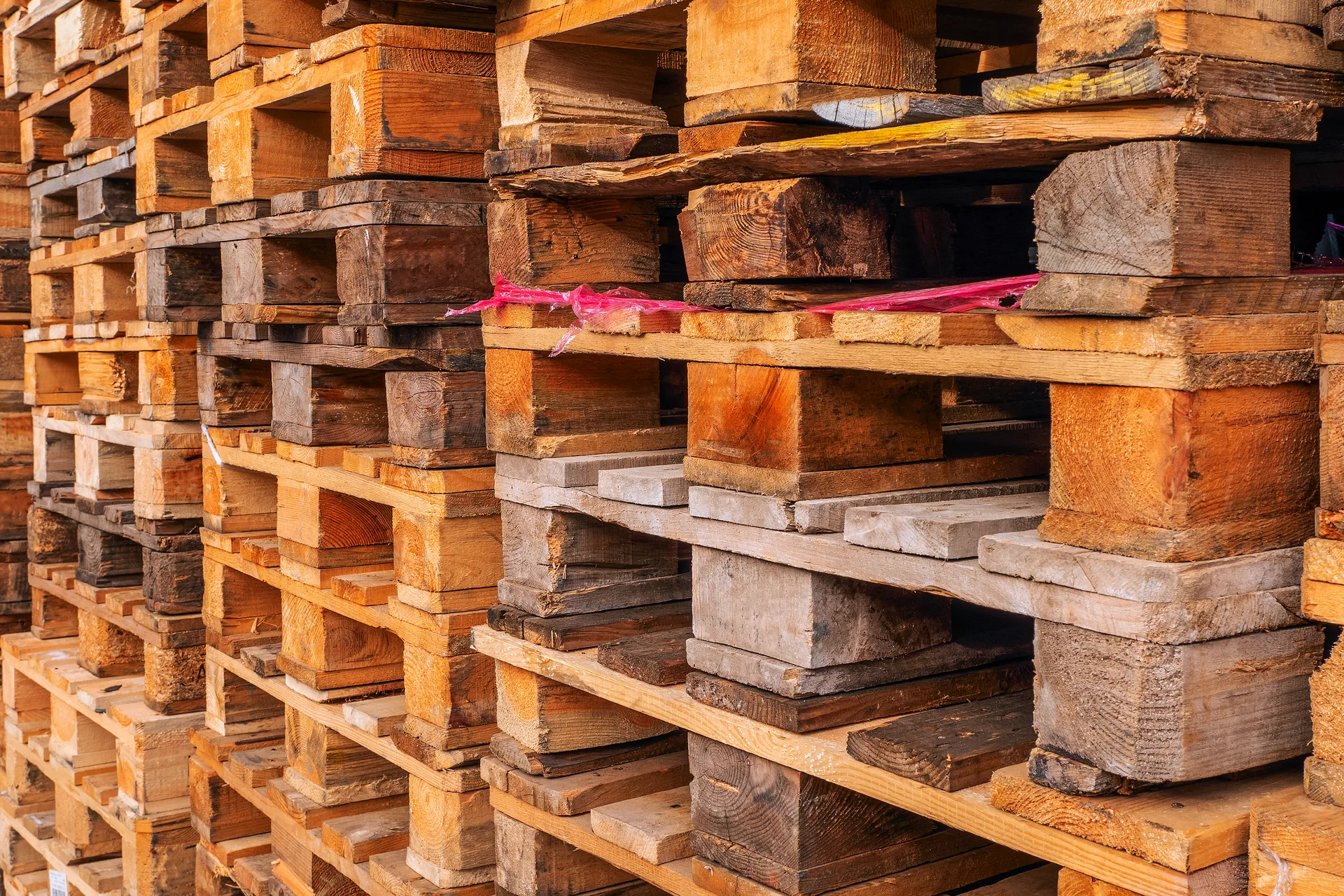
Block-style construction can offer openings on four sides for forks, while bearer layouts can restrict approach directions or use notches. The precise openings and underside determine what equipment fits; do not infer four-way pallet-truck access from a forklift description.
State your equipment type and preferred approach direction, and share underside photographs of an accepted pallet. Racking suitability, load distribution and support need their own checks.
Condition and repeat purchasing
Choose used condition around the actual work: repeated lifting, a customer’s repair restrictions, contamination sensitivity and how consistently the pallets must match. Weathered timber colour is not evidence of strength or export treatment.
For repeat supply, describe order quantity, frequency and notice, and identify features that must remain consistent. For a licensed pool requirement, ask for the specific acceptance route rather than treating all Euro-size stock as exchangeable. Call 023 9239 7737 to discuss the specification and delivery quote.
Specify more than the footprint
Used wooden pallets at 1200 × 800 mm may have different construction, markings, repairs and histories. If your customer or logistics system requires a licensed or exchangeable pallet, state the exact scheme and acceptance rules at the beginning of the enquiry.
Do not rely on a familiar mark without checking its legibility, authenticity, repair status and relevance to the current use. We will not describe an ordinary Euro-size pallet as EPAL or exchange eligible unless that status has been specifically established.
Condition and handling
Explain whether the pallet will be used with racking, automated handling, conveyor systems or specific equipment. Mention the load, how it is distributed and any customer specification. Cosmetic variation in reused timber is normal; structural and operational suitability is the priority.
If matching an existing pallet, send clear photographs, full dimensions and close-ups of the construction and marks. Quantity, postcode, access, unloading and timing help us form a practical quotation.
Heat-treated used pallets for export
We can supply used pallets already heat-treated and correctly marked for ISPM 15, or arrange treatment through a registered partner. Both options are subject to the required specification, availability and destination requirements.
A 1200 × 800 footprint does not establish ISPM 15 status. Check official guidance and discuss the actual marks, repair history, destination and specification before arranging export use. Euro size also does not establish EPAL licence or exchange eligibility.
Useful answers
Common questions
Does Euro-size mean EPAL?
Licensing, pool status, and exchange eligibility are established by specific markings and certification rather than size alone.
Are Euro-size pallets automatically suitable for export?
No. Export requirements and the individual pallet's status must be checked separately.